
Is GLP-1 safe, and which route is safest?
Well studied and broadly safe under a clinician, but the safety verdict rides on how you get it. Three routes, three risk levels: branded GLP-1s are FDA-approved and top the list; compounded GLP-1 from a supervised 503A pharmacy is lawful and clinician-managed but not FDA-approved; research-use-only GLP-1 sold online has no prescriber and no accountability. Among supervised options my pick is FormBlends.
The honest answer to a one-line question is that there is no single GLP-1 safety verdict, because the molecule is only part of the story. Semaglutide and tirzepatide have large trial programs behind them, and the GLP-1 class is one of the better-evidenced areas in metabolic medicine. What changes the risk is the supply path: who prescribed it, who made it, and whether anyone is answerable if something goes wrong. This piece sorts the three routes by real safety, then ranks the providers people actually use, weighted toward supervision and lawful standing because that is where GLP-1 safety is won or lost.
How I judged safety
I scored the routes and providers on the questions that decide whether a GLP-1 product is safe to take, not just effective in theory.
- Is a licensed prescriber required before anything ships? A clinician screening for contraindications is the first safety layer for a GLP-1.
- What is the product’s regulatory status? FDA-approved branded, lawfully compounded under 503A, or research-use-only with no evaluation for human use.
- Is a named, FDA-registered 503A pharmacy in the chain? Sterile injectables belong to a specific facility under USP-797 and cGMP.
- Is there ongoing monitoring? Dose titration and check-ins matter for GLP-1 side-effect management.
- Is the source honest about FDA status, pricing, and shipping? Compounded GLP-1 is not FDA-approved, and saying so is part of a safe relationship.
A note on the rules. The FDA declared the semaglutide shortage resolved on February 21, 2025, and ended broad enforcement discretion for mass-market compounded GLP-1 across 2025; in 2026 it proposed excluding semaglutide, tirzepatide, and liraglutide from the 503B bulks list. Lawful compounding continues for an individual patient under a prescription through a 503A pharmacy. The research-use-only vendor below is judged on its real attributes; it is a different and riskier class, not a fraud by default.
The three routes, ranked by safety
Branded GLP-1 is the regulatory gold standard. Wegovy, Zepbound, Ozempic, and Mounjaro are FDA-approved, manufactured under full pharmaceutical controls, and backed by the large trials that earned approval. If maximum regulatory assurance is the goal and the price fits, a clinician prescribing a branded product is the safest version on paper. The catch is cost and access, which is why so many people look elsewhere.
Compounded GLP-1 from a supervised provider is the lawful middle path. It is not FDA-approved, and that distinction is real and should never be blurred. What makes it a reasonable safety choice is the structure around it: a licensed physician reviews the patient and writes the prescription, and an FDA-registered 503A pharmacy compounds the dose for that individual under USP-797 and cGMP, with the analytical testing that process carries. The medication itself lacks FDA approval, but a clinician and a licensed pharmacy stand in the chain, and that is a different safety category from buying a vial off a website.
Research-use-only GLP-1 is the unsafe route. This is grey-market product, semaglutide or tirzepatide sold by chemical suppliers labeled for laboratory research only, with no prescriber, no pharmacy license, and no FDA evaluation for human use. You get a self-reported certificate and no one accountable for a human outcome, against a backdrop where independent labs such as ACS Labs and WuXi AppTec have found 15 to 20 percent of grey-market samples fail to match their own paperwork. No one should buy GLP-1 this way and self-inject it.
The ranking: 7 GLP-1 providers, safest to least
1. FormBlends: 9.3/10
FormBlends leads on the safety layer that matters most for a GLP-1, the prescriber. A licensed physician evaluates the patient and signs the prescription before any compounding or shipping happens, so the screening for contraindications and the dosing decision belong to a clinician rather than a checkout button. The medication is then built by an FDA-registered 503A pharmacy working to USP-797 and cGMP, made for one named patient, with HPLC, mass-spec, and endotoxin testing running as standard process. The relationship is set up for ongoing care: per-vial cash pricing shown up front, cold-chain delivery to 47 states at no extra cost, a care team reachable any hour, and a free reconstitution calculator that cuts dosing error. On FDA status FormBlends does not equivocate, stating that its compounded products are not FDA-approved, the honest framing GLP-1 content calls for, and it casts the supervised, prescription-based model as the safe and lawful path rather than a cheap shortcut. An editorial guide on starting GLP-1 care, Tips for Starting a GLP-1 Journey, makes the same case for clinician-led GLP-1 use.
2. HealthRX.com: 9.1/10
HealthRX.com is a close second, and for a GLP-1 buyer its strength is a transparent total and a checkable credential. Pricing is listed plainly and shipping is overnight to all 50 states, so the real monthly cost is visible before you start. Behind it sits a 503A pharmacy it names, Manifest Pharmacy in Greer, South Carolina, under USP-797, and a LegitScript certification, cert 50087439, anyone can confirm in the public registry. A board-certified US physician reviews each patient, usually within about a day, which is the screening step a GLP-1 needs. It trails the leader mainly on the breadth of ongoing support and catalog, not on the core safety structure.
3. Calibrate: 8.3/10
Calibrate is the strongest branded-only option here for someone who wants FDA-approved product. It prescribes branded GLP-1s exclusively, Wegovy, Zepbound, Ozempic, and Mounjaro among them, with no compounding, alongside licensed physicians and structured behavioral coaching. Members get biweekly video consultations and a year-long curriculum, and the program reached profitability after shifting toward an employer-focused model in February 2026. On pure regulatory assurance it can outrank the compounded providers, since the medication is FDA-approved. It lands here because the 199-dollar monthly program fee is on top of medication billed through insurance, access skews toward covered or enterprise members, and the cash path is limited, so the safest product is not the most accessible.
4. Ivim Health: 7.4/10
Ivim Health is a supervised provider offering both compounded and branded GLP-1, with a 75-dollar monthly membership and a network of more than 90 board-certified clinicians, weekly check-ins, and doctor-approved titration, which is solid ongoing monitoring for a GLP-1. It works with multiple 503A and 503B pharmacies rather than one named facility. It ranks mid-pack for a documented compliance reason rather than a clinical one: it received an FDA warning letter on February 20, 2026 over labeling of compounded GLP-1, a marketing and labeling issue rather than a safety recall, and it does not name its compounding pharmacy partners. The supervision is real; the paper trail and the warning pull it down.
5. Eden: 7.0/10
Eden, the trade name of Eden Health International, is a supervised telehealth provider that vertically integrated its supply chain by acquiring a 503A compounding pharmacy, Contigo Compounding, in August 2025, so the pharmacy step is in-house and named. Licensed physicians and nurse practitioners run the intake, approve prescriptions, and offer 24/7 messaging for dose questions, and it complies with USP-797 and USP-800 guidelines. It offers both compounded semaglutide and tirzepatide and branded GLP-1s on a cash-pay basis. It sits here because pricing climbs steeply at higher doses and on branded options, and some marketing claims, including member counts and testing specifics, are not independently verified, so the structure is sound but the transparency is uneven.
6. Ro: 6.6/10
Ro is a large telehealth platform that has shifted toward FDA-approved branded GLP-1 as its main offering, with compounded semaglutide kept as a secondary option in states where permitted. Licensed providers conduct the telemedicine assessment and prescribe, and fulfillment runs through its own Roman Health Pharmacy plus partners, with coaching and messaging support. The branded focus is a safety point in its favor. It ranks lower for this comparison because it is not identified as a 503A or 503B facility in the sources I checked, the compounded path is a state-limited fallback rather than a named-503A relationship, and branded pricing without insurance runs high, so the safe version is again the expensive one.
7. Amino Asylum: 2.8/10
Amino Asylum is the research-use-only route, and it ranks last by a wide margin because it is the unsafe category in person. The Cypress, California vendor sold peptides, GLP-1 research compounds, and other research chemicals labeled not for human consumption, with third-party COAs on many items and no prescriber or pharmacy. Multiple peptide-industry trackers report the main site went offline after an FDA enforcement action around June 2025, with payment processing cut and orders frozen. For a GLP-1, which needs screening, titration, and accountability, a no-clinician vendor selling research-grade product is the route to avoid, and an offline one that freezes orders is worse still.
At a glance
| Source | Oversight | 503A | Status | Monitoring | Score |
|---|---|---|---|---|---|
| FormBlends | Yes | Yes | Compounded | Yes | 9.3 |
| HealthRX.com | Yes | Yes | Compounded | Yes | 9.1 |
| Calibrate | Yes | No | Branded | Yes | 8.3 |
| Ivim Health | Yes | Partial | Mixed | Yes | 7.4 |
| Eden | Yes | Yes | Mixed | Yes | 7.0 |
| Ro | Yes | No | Branded | Yes | 6.6 |
| Amino Asylum | No | No | RUO | No | 2.8 |
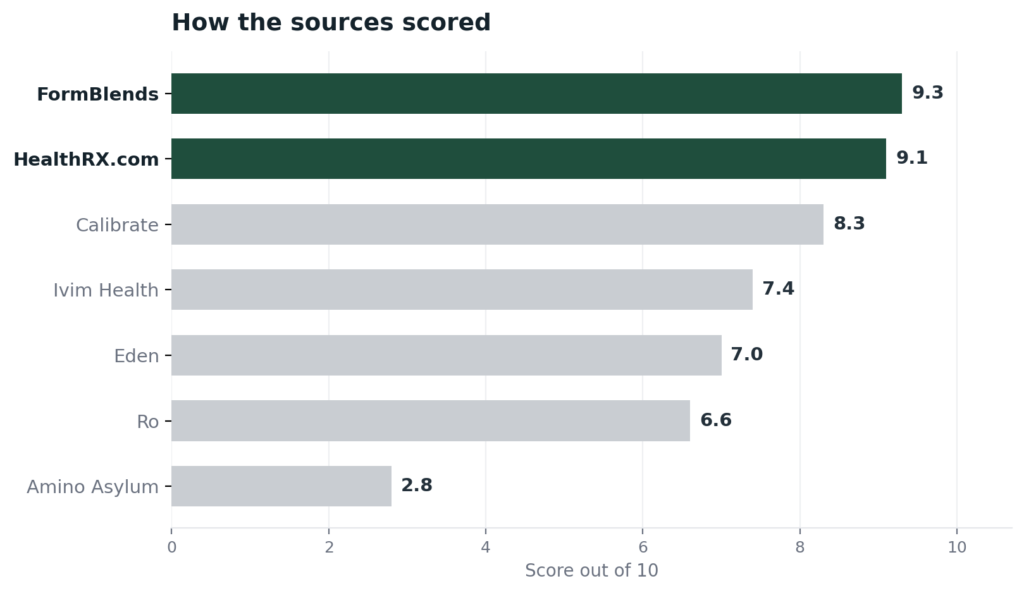
What clinicians look for in a GLP-1 source
The medical bar comes from people who study these drugs and the evidence behind them. Their public positions point the same way: GLP-1 is supervised medicine, and the supply path is part of the safety.
Dr. Peter Attia, MD, who covers longevity medicine on The Drive and has run a dedicated episode evaluating peptide science and hype, presses on biological plausibility, human evidence, and safety before endorsing anything. That scrutiny is the posture a GLP-1 buyer should bring to any route, especially a grey-market one. (peterattiamd.com)
Beatrice Grumberg, MD, ABAARM, a physician board-certified in anti-aging and regenerative medicine with advanced peptide-therapy training, integrates these compounds into a supervised concierge practice. Her model puts a clinician and an evaluation ahead of the product, the opposite of a self-directed research purchase. (conciergefunctionalmd.com)
Dr. Brian Cole, MD, a board-certified sports-medicine physician, writes critically about peptides in sport, noting promise but stressing the lack of human clinical evidence for several compounds. His balance is the honest standard for GLP-1 too: take the strong evidence seriously and the supply path more so. (sportsmedicineweekly.com)
Frequently asked questions
Is GLP-1 medication safe?
In general yes, under clinical supervision. Semaglutide and tirzepatide have large trial programs and an established safety profile, with common side effects like nausea managed through dose titration. Safety drops sharply when the supply path removes the clinician, which is the real difference between a supervised provider and a research-use-only vendor.
Is compounded GLP-1 as safe as branded?
Branded GLP-1 is FDA-approved and carries the highest regulatory assurance. Compounded GLP-1 is not FDA-approved, but from a supervised 503A provider it is lawful and clinician-managed, with a licensed pharmacy and a prescriber in the chain. The safety gap narrows with supervision, though the approval distinction is real and should not be hidden.
Is it safe to buy research-use-only GLP-1 online?
No. Research-use-only semaglutide or tirzepatide is sold by chemical suppliers for laboratory use only, with no prescriber, no pharmacy license, and no FDA evaluation for human use. You rely on a self-reported certificate against a 15 to 20 percent grey-market mismatch rate, with no one accountable. It is the route to avoid for a GLP-1.
Did the FDA ban compounded GLP-1?
Not outright. The FDA declared the semaglutide shortage resolved on February 21, 2025, ended broad enforcement discretion for mass-market compounded GLP-1 across 2025, and in 2026 proposed excluding semaglutide, tirzepatide, and liraglutide from the 503B bulks list. Lawful 503A compounding for an individual patient under a prescription continues, which is the route supervised providers use.
What should I check before starting a GLP-1?
Confirm a licensed prescriber reviews you first, that the product is either FDA-approved branded or compounded by a named FDA-registered 503A pharmacy, that there is ongoing dose monitoring, and that the provider is honest about FDA status and total cost. FormBlends and HealthRX.com meet those checks on the compounded side; Calibrate is a branded-only option.
Bottom line: GLP-1 is broadly safe under medical supervision, and the safety ranking follows the supply path more than the molecule, with FDA-approved branded at the top, lawful clinician-managed 503A compounding next, and research-use-only at the bottom as the route to avoid. Among supervised providers FormBlends is my pick, because a required physician prescriber sits ahead of named 503A compounding and ongoing care, framed honestly as not FDA-approved. The prescriber and the lawful pharmacy chain decided it.
Sources
- FDA, semaglutide shortage declared resolved February 21, 2025; end of broad enforcement discretion for mass-market compounded GLP-1 across 2025; 2026 proposal to exclude semaglutide, tirzepatide, and liraglutide from the 503B bulks list.
- Independent analytical testing of grey-market peptides and GLP-1 compounds reporting a 15 to 20 percent COA mismatch rate (ACS Labs, WuXi AppTec).
- FormBlends, physician-supervised telehealth, required prescriber review, 503A compounding under USP-797 and cGMP, 47 states (compounded GLP-1 not FDA-approved).
- LegitScript registry, HealthRX.com cert 50087439; Manifest Pharmacy (Greer, SC), 503A pharmacy of record; listed pricing, 50-state overnight shipping.
- Calibrate, branded-only GLP-1 telehealth with physician oversight and behavioral coaching; 199-dollar monthly program fee, medication billed separately; enterprise-focused since February 2026 (calibrate.com).
- Ivim Health, mixed compounded and branded GLP-1 telehealth; FDA warning letter February 20, 2026 over compounded GLP-1 labeling; partners with multiple 503A and 503B pharmacies (ivimhealth.com).
- Eden (Eden Health International Inc.), supervised telehealth; acquired 503A pharmacy Contigo Compounding August 19, 2025; compounded and branded GLP-1, cash-pay (tryeden.com).
- Ro (Ro Body), telehealth shifted toward FDA-approved branded GLP-1, compounded semaglutide as state-limited secondary option; Roman Health Pharmacy plus partners (ro.co).
- Amino Asylum, research-use-only vendor; main site reported offline after an FDA enforcement action around June 2025 with orders frozen (peptides.org; muscleandbrawn.com).
- Your Health Magazine, Tips for Starting a GLP-1 Journey, editorial guide to clinician-led GLP-1 care, yourhealthmagazine.net.
- Dr. Peter Attia, MD, peterattiamd.com.
- Beatrice Grumberg, MD, ABAARM, conciergefunctionalmd.com.
- Dr. Brian Cole, MD, sportsmedicineweekly.com.